

Explore Consciousness.
Build Community | Workshops and Events | Brainwave Audio
“You are more than your physical body.”
- Robert Monroe
Understanding Brainwave States and Brainwave Entrainment
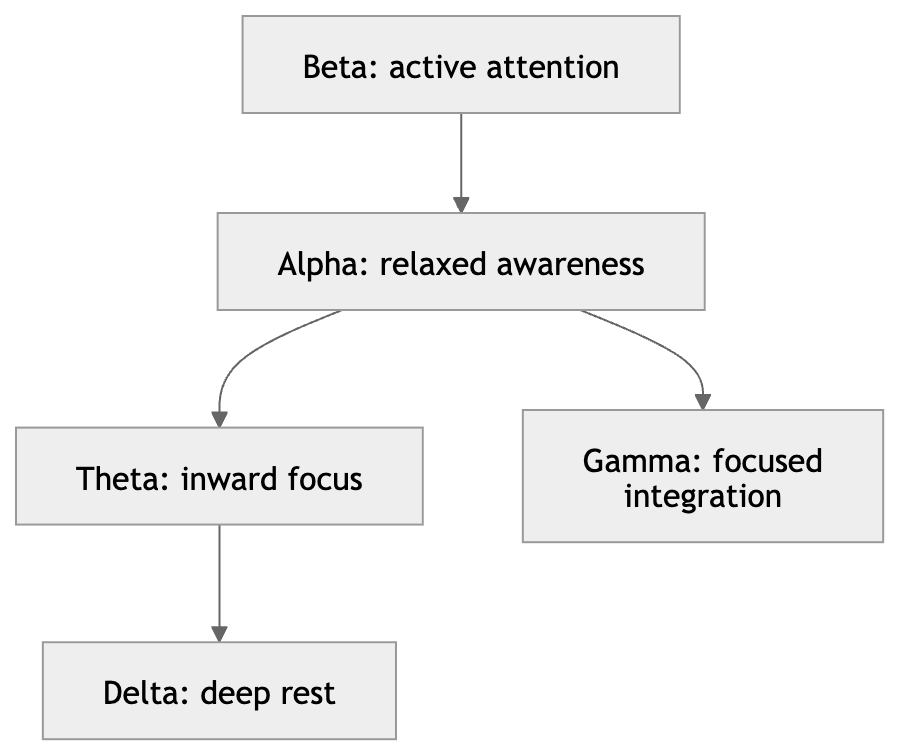
The brain is constantly producing patterns of electrical activity that can be measured with electroencephalography, or EEG. Researchers commonly organize these patterns into five frequency ranges: delta, theta, alpha, beta, and gamma.
Each brainwave band is associated with particular aspects of sleep, attention, memory, perception, and consciousness. However, the brain does not operate in only one frequency at a time. Multiple rhythms occur simultaneously across different brain regions, and their functions overlap. Brainwave states are best understood as dynamic patterns rather than fixed settings.
How Brainwave Entrainment May Influence These States
Brainwave entrainment uses repetitive sensory rhythms—usually sound, light, or a combination of the two—to encourage corresponding rhythmic responses in the nervous system.
Auditory entrainment can include:
Binaural beats
Monaural beats
Isochronic tones
Rhythmic pulses
Music and environmental sound
Frequency, amplitude, and phase modulation
With binaural beats, two slightly different tones are presented separately to each ear through stereo headphones. The brain perceives the difference between the tones as a rhythmic beat.
For example, if one ear receives a 200-hertz tone and the other receives a 210-hertz tone, the listener perceives a beat at approximately 10 hertz—within the alpha range. A difference of approximately 6 hertz would fall within the theta range, while a difference of 40 hertz would fall within the gamma range.
Brainwave-entrainment audio may be designed around a single frequency range or may gradually guide the listener through a sequence of states:
A relaxation recording might guide the listener from beta into alpha and theta. A sleep recording may continue toward delta. A learning or insight-oriented program might combine relaxed alpha activity with periods of beta or gamma-range stimulation.
Listening to a 10-hertz or 40-hertz beat does not mean that the entire brain automatically begins operating at that frequency. Brain responses vary according to the person, audio design, volume, listening duration, mental state, and neural system being measured. Entrainment is better understood as a possible influence on brain activity—not a command that forces the brain into a predetermined state.
-
Approximate frequency: 0.5–4 Hz
Delta waves are the slowest of the principal brainwave rhythms. They become most prominent during deep, dreamless stages of non-REM sleep, when awareness of the external environment is significantly reduced.
Deep sleep supports physical recovery, immune function, hormonal regulation, and memory consolidation. Delta activity can also occur locally in the waking brain, so it is not exclusively a sleep rhythm.
Delta-oriented entrainment audio is commonly used to support:
Deep rest
Sleep preparation
Physical relaxation and recovery
Release of ordinary waking awareness
Because delta-oriented programs may produce substantial drowsiness, they should only be used in a safe setting where alertness is not required.
-
Approximate frequency: 4–8 Hz
Theta waves are associated with drowsiness, early sleep, dreaming, memory processing, creative imagery, and certain forms of meditation. Theta often becomes more prominent in the transitional state between waking and sleep—the period when the body is deeply relaxed but some awareness may remain.
During waking activities, theta oscillations also participate in learning, working memory, emotional processing, and cognitive control. Theta therefore has more than one function, depending on where in the brain it occurs and what the person is experiencing.
Theta-oriented entrainment audio may support:
Deep meditation
Visualization and creative insight
Intuitive or inwardly directed awareness
Exploration of memories and emotions
Hypnagogic experiences
The transition between wakefulness and sleep
Theta is frequently emphasized in audio created for inner exploration because it is associated with reduced attention to the external environment and increased receptivity to internal imagery.
-
Approximate frequency: 8–13 Hz
Alpha activity commonly increases during relaxed wakefulness, especially when the eyes are closed. It often decreases when the eyes open or when a person begins concentrating intensely on an external task.
Alpha was once considered an “idling” rhythm, but research now suggests that it actively helps regulate attention. It may help the brain inhibit irrelevant sensory information, reduce distraction, and direct resources toward selected experiences.
Alpha-oriented entrainment audio is commonly used to support:
Relaxed but conscious awareness
Stress reduction
Mindfulness and meditation
Creative reflection
Mental and emotional centering
The transition from active thinking into deeper relaxation
For people who are new to meditation, alpha-oriented recordings may provide an accessible entry point. The listener can remain awake and aware while allowing the body and mind to settle.
-
Approximate frequency: 13–30 Hz
Beta waves are associated with ordinary waking consciousness, active thought, concentration, planning, decision-making, and engagement with the external environment.
Moderate beta activity is part of healthy attention and productive mental effort. Faster beta activity may appear during intense concentration, vigilance, or stress, although beta waves themselves do not simply “cause anxiety.” Their meaning depends on the location, intensity, and overall pattern of brain activity.
Beta-oriented entrainment audio may support:
Focus and concentration
Mental clarity
Motivation
Study or work
Problem-solving
Goal-directed activity
Not all brainwave entrainment is intended to produce relaxation. Some recordings are specifically created to promote alertness and cognitive engagement.
-
Gamma waves are the fastest of the commonly discussed brainwave rhythms. They are associated with the rapid coordination of information across brain regions and may help integrate separate sensory, cognitive, and emotional elements into a unified experience.
For example, the brain processes an object’s color, shape, location, movement, and meaning through different neural systems. Gamma synchronization is thought to contribute to “binding” these separate features together so the object is experienced as a coherent whole.
Gamma activity has been associated with:
Focused attention
Sensory processing and perceptual clarity
Learning and memory formation
Retrieval of previously learned information
Integration of information across neural networks
Complex cognitive processing
Conscious awareness
Gamma oscillations also appear to interact with slower rhythms. In the hippocampus and related memory systems, gamma activity can become organized within particular phases of theta waves. This theta-gamma coordination may help the brain sequence, encode, and retrieve information. The relationship illustrates an important point: healthy brain function depends not only on the strength of an individual frequency, but also on communication among different frequencies.
Gamma Waves and Meditation
Researchers have observed unusual patterns of gamma activity in some highly experienced meditators, particularly during practices involving compassion, nondual awareness, and open monitoring. These findings have prompted interest in gamma activity as a possible neurological correlate of heightened clarity, integration, and sustained awareness.
However, gamma should not be described as a direct measurement of enlightenment, spiritual advancement, or expanded consciousness. Gamma oscillations participate in many ordinary neurological processes, and elevated gamma activity can have different meanings depending on the brain region, timing, and condition being studied.
Gamma-oriented entrainment audio is commonly intended to support:
Sustained attention
Mental clarity
Learning and memory
Integration of complex information
Insight-oriented meditation
Heightened sensory or present-moment awareness
Research into whether binaural beats or other forms of auditory stimulation can reliably increase beneficial gamma activity is still emerging. Some studies report frequency-following responses and changes in gamma-band activity, while others find smaller or inconsistent effects.
What Does the Research Show?
Scientific research supports the general principle that the brain responds to rhythmic sensory stimulation. Studies of binaural beats and other auditory techniques have reported potential benefits involving relaxation, anxiety, attention, memory, pain perception, and sleep.
Nevertheless, evidence that binaural beats consistently shift brain activity into a selected frequency band remains mixed. A 2023 systematic review examined 14 EEG studies of binaural-beat stimulation. Five studies reported evidence consistent with brainwave entrainment, eight produced contradictory findings, and one reported mixed results. The authors noted substantial differences in listening protocols, frequencies, study design, participant characteristics, and EEG measurements.
The effects of brainwave-entrainment audio may therefore come from several interacting elements:
Rhythmic stimulation of the auditory system
Changes in attention and sensory processing
Music and environmental sound
Guided meditation or visualization
Reduced external distraction
Relaxation and expectation
Personal intention
Consistent time devoted to inner practice
Brainwave entrainment is best regarded as a supportive tool rather than a technology that guarantees a specific mental, neurological, or spiritual state. Its practical value lies in whether it helps the individual enter relaxation, meditation, focus, sleep, or self-exploration more easily and consistently.
Monroe Sound Science and Hemi-Sync
Robert A. Monroe was an early pioneer in using sound to support relaxation, meditation, and the exploration of consciousness. His experiments led to the development of Hemi-Sync®, or hemispheric synchronization.
Hemi-Sync audio uses binaural beats together with music, verbal guidance, and layered sound patterns. Programs may incorporate different frequency ranges to support relaxation, sleep, focused attention, meditation, or expanded states of awareness.
The Monroe Institute’s contemporary sound technology is known as Monroe Sound Science™. According to the Institute, Monroe Sound Science combines binaural beats with additional techniques, including frequency, amplitude, and phase modulation. This allows an audio exercise to create a more complex and progressive sound environment than a single, continuous binaural beat.
Monroe programs generally do not treat one brainwave frequency as a shortcut to a specific experience. Instead, the sound technology works alongside relaxation, focused attention, guided exercises, personal intention, and repeated practice.
Hemi-Sync and the Monroe Institute are now separate organizations. Hemi-Sync continues to produce recordings based on Robert Monroe’s original technology, while the Monroe Institute develops its current audio programs using Monroe Sound Science.

Monroe Sound Science uses brainwave entrainment audio to help guide you into deeper states of focus, relaxation, and expanded awareness.
This is an affiliate link, which means we may earn a small commission on introductory programs booked at no extra cost to you. You may also use the coupon code: EnResonance.
References
Ingendoh, R. M., Posny, E. S., & Heine, A. (2023). Binaural beats to entrain the brain? A systematic review of the effects of binaural-beat stimulation on brain oscillatory activity and the implications for psychological research and intervention. PLOS ONE, 18(5), e0286023. https://doi.org/10.1371/journal.pone.0286023
Garcia-Argibay, M., Santed, M. A., & Reales, J. M. (2019). Efficacy of binaural auditory beats in cognition, anxiety, and pain perception: A meta-analysis. Psychological Research, 83(2), 357–372. https://doi.org/10.1007/s00426-018-1066-8
Klimesch, W. (2012). Alpha-band oscillations, attention, and controlled access to stored information. Trends in Cognitive Sciences, 16(12), 606–617. https://doi.org/10.1016/j.tics.2012.10.007
Jensen, O., & Colgin, L. L. (2007). Cross-frequency coupling between neuronal oscillations. Trends in Cognitive Sciences, 11(7), 267–269. https://doi.org/10.1016/j.tics.2007.05.003
Jensen, O., Kaiser, J., & Lachaux, J.-P. (2007). Human gamma-frequency oscillations associated with attention and memory. Trends in Neurosciences, 30(7), 317–324. https://doi.org/10.1016/j.tins.2007.05.001
Lutz, A., Greischar, L. L., Rawlings, N. B., Ricard, M., & Davidson, R. J. (2004). Long-term meditators self-induce high-amplitude gamma synchrony during mental practice. Proceedings of the National Academy of Sciences, 101(46), 16369–16373. https://doi.org/10.1073/pnas.0407401101
Chaieb, L., Wilpert, E. C., Reber, T. P., & Fell, J. (2015). Auditory-beat stimulation and its effects on cognition and mood states. Frontiers in Psychiatry, 6, 70. https://doi.org/10.3389/fpsyt.2015.00070
The Monroe Institute. Monroe Sound Science. https://www.monroeinstitute.org/pages/monroe-sound-science